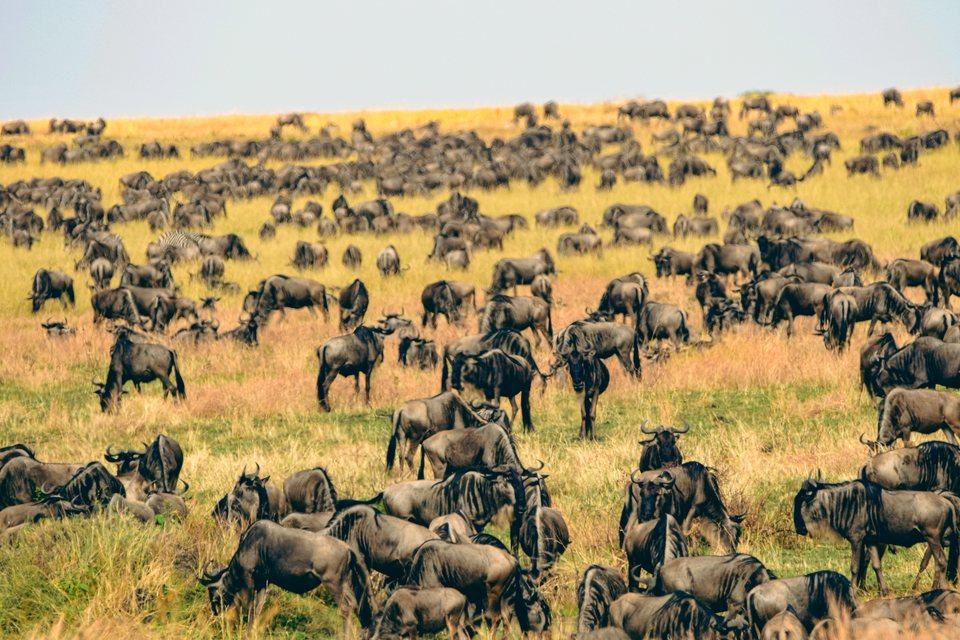
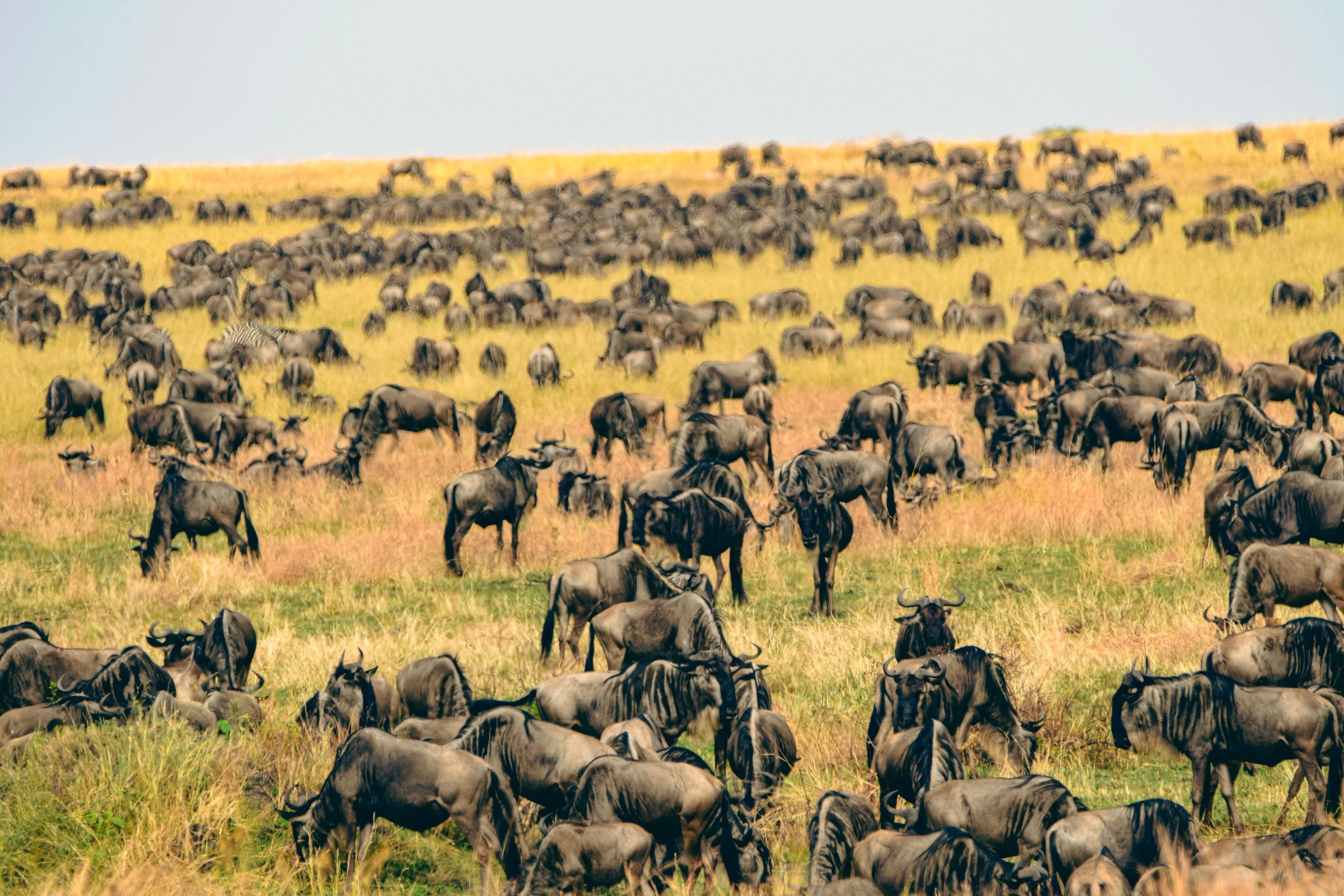
The Great Migration is one of nature's greatest spectacles: more than 1 million wildebeest and hundreds of thousands of zebras and gazelles, on the move all year round. You still need to be in the right place at the right time. At The Wild Agency, we follow the herds closely to place our travellers where the action is, always with respect for the animals.
How does the Great Migration work?
The herds do not follow a date, they follow the rain. They look for fresh grass and travel in a great loop between Tanzania and Kenya. The cycle repeats every year, a few weeks earlier or later depending on the rains.
Where can you see the migration each month?
December to March: calving
The herds gather on the plains of the southern Serengeti, around Ndutu. In February especially, thousands of wildebeest calves are born within a few weeks. Lions, cheetahs and hyenas are never far away: it is an intense period, and often a quieter one.
April to July: heading north
In April and May, the herds move up through the central Serengeti, then towards the Western Corridor. In June and July, they cross the crocodile-filled Grumeti River.
July to September: the Mara crossings
This is the most famous moment. The herds reach the northern Serengeti and the Masai Mara, and cross the Mara River, sometimes several times. A crossing cannot be scheduled: a herd may hesitate for hours before plunging in, or give up altogether.
It is also the busiest period. On the riverbank, dozens of vehicles can wait at the same spot, and too many people can disturb the animals just as they are about to cross.
October and November: back to Tanzania
In October, the herds leave the Masai Mara and cross back into Tanzania. In November, with the short rains, they move down through the eastern Serengeti towards the southern plains, where the cycle begins again.
How can you see the migration without disturbing the animals?
The migration draws huge numbers of visitors, especially from July to September. The goal is not to see a crossing at any cost, but to experience it without disturbing the herds. At The Wild Agency, ethics are part of our values, and our guides put them into practice in the field.
Keeping our distance
Our guides stay well back from the animals and never block their path to the river. They switch off the engine, speak quietly and let the herds choose their moment.
Leaving when there are too many vehicles
If we see too many vehicles in one spot, we move on. There are always other herds to watch further away, in peace, and often for a far more memorable moment.
We would rather have a calm, respectful sighting than a crossing watched from the middle of 50 vehicles.
That is how we travel: thoughtful, respectful tourism that protects the animals and the migration for years to come.
Kenya or Tanzania to see the migration?
Both countries offer the migration, but not in the same months. Kenya, with the Masai Mara, is ideal from July to September. Tanzania lets you follow it for almost the whole year.
 Related readingKenya or Tanzania: which country for a safari?Read the article
The migration feels different in every season. The key is to pick the season that excites you most, then the right lodge in the right place.
Frequently asked questions about the Great Migration
When can you see the Great Migration?
All year round, but in different places: in the southern Serengeti from December to March, in the north and the Masai Mara from July to September, then in the eastern Serengeti in October and November.
When do the Mara River crossings take place?
Usually from July to September, sometimes into October. They depend on the rains and are never guaranteed.
How many days do you need to see the migration?
Allow at least 3 nights on site, ideally 4, to give yourself a real chance.
Is it crowded during the migration?
Yes, especially from July to September along the Mara River. To enjoy it without the crowds or disturbing the animals, stay several nights and head out early in the morning.
Does The Wild Agency organise migration safaris?
Yes. The Wild Agency chooses the lodges and areas according to where the herds are at the time of your trip. Our guides respect the animals: they keep their distance, and they move on when there are too many vehicles.